For years, the only obstacle between Cameron Young and taking down the biggest fields in golf was a faulty putter. In his first season on the PGA Tour (2021-22), Young ranked second on Tour off the tee, sandwiched between Jon Rahm and Rory McIlroy. He finished runner-up five times that season, a few missed putts away from earning his first PGA Tour win.
The next couple of years brought more of the same: elite ball-striking performances squandered by struggles with the putter. The 2023 Open Championship was a particularly frustrating episode for Young, who played his way into the final pairing despite missing every putt he looked at all week, ultimately falling to a T-8 finish. Between 2022 and 2023, Young posted four top 10s in his eight major championship appearances — as many as any golfer outside of McIlroy and Scottie Scheffler during that span. The signs of a budding star have always been there: ball-striking that stands shoulder to shoulder with the best in the game, paired with an inconsistent putter.
His biggest flaw is now a remnant of the past.
Young’s fortunes with the flatstick changed drastically last year, when he ranked seventh on Tour in Strokes Gained: Putting, a radical transformation from the prior two seasons, in which he’d ranked outside the top 125. This past week at TPC Sawgrass, I asked his father, David — a PGA professional and the only instructor Young has ever had — what he attributes to the significant improvement in Cam’s putting. He said Cam’s technique has always been sound, but a couple of small adjustments, including to his alignment, enabled him to start more putts on line. Better start lines not only helped Cam roll better putts, but also allowed him to glean better information and visualize putts more clearly.
Whatever work Cam has put in, it has been effective.
The putter carried him to his maiden PGA Tour win at last August’s Wyndham Championship, where he led the field in putting en route to a six-shot victory. Then, on the biggest stage on Sunday at the Ryder Cup in September, Young buried a clutch putt on 18 to defeat Justin Rose, 1 up, and keep hopes of a miraculous American comeback alive. It was a small moment, just one putt, but it defined the evolution of Young’s game. The piece of his game that had failed him in so many crucial moments hadn’t just held up during a blowout win in Greensboro, North Carolina, it withstood the most pressure-packed cauldron in the sport.
At the Players Championship, Cameron Young once again proved he can beat anybody anywhere, assembling a complete performance to take down one of the strongest fields in golf in one of the sport’s most stressful amphitheaters.
A double-bogey on the 18th hole on Saturday evening placed Young in the penultimate pairing entering Sunday, four shots behind Ludvig Aberg. He holed a 15-foot birdie putt to start the final round, the type of putt that wouldn’t have touched the hole two years ago. As Aberg’s round unraveled early on his back nine, Young lurked near the top of the board, birdieing Nos. 10 and 13 to move to 3 under for the round on a challenging Sunday setup where the field averaged +0.67 to par. A testy six-foot par save on 14 tied Young for the lead with playing partner Matt Fitzpatrick while Aberg imploded behind them.
{{inline-article}}
Walking to the 17th tee, Fitzpatrick held a one-stroke advantage and hit a safe, solid wedge 30 feet from the traditional back-right Sunday hole location. Young took a more aggressive line, sticking his sand wedge to just inside 10 feet with the tournament on the line. The putter delivered in a high-leverage spot once again, and he dripped the delicate right-to-left breaker over the lip and into the center of the cup. The pairing was all square heading to one of the most intimidating tee shots in golf, where Young had rinsed his drive the previous day.
“My thought process over that ball is, one, making sure that I’m committed to my line, and two, the overarching thought is I’m going to hit the best shot of my life right here,” Young said in his victory press conference. “I don’t know if I can think of one that’s better.”
A better tee shot may not have been possible. He ripped a tightly drawn missile 375 yards down the right side of the fairway — the longest tee shot on record on the 18th hole at TPC Sawgrass — leaving just 98 yards to a back hole location. We may never see a better tee shot on that hole, especially considering the moment.
When Fitzpatrick failed to get up-and-down for par, all that remained for Young was to tap in a putt just over a foot in length to secure the biggest win of his career to date.
“I’m kind of trying to give up on that, in terms of looking at where I am versus where I think I should be in my career,” Young said after the win. “My expectations are wildly unreasonable, so I think they’re less so now. I think they have been wildly unreasonable.”
With major season bearing down, even Young’s harshest critics should have high expectations for the 28-year-old American, who has now won twice in 11 starts with a dominant Ryder Cup showing sprinkled in. Over the last four seasons, he has recorded more top-10 finishes (six) in majors than any other player without a major victory. This time around, however, an in-form Young will be taking his most complete skill set yet — and a renewed sense of confidence — to the biggest stages.
TPC Sawgrass Got Muirfield Village-ified
Outside of Young, the star of the Players Championship was TPC Sawgrass. Pete Dye’s signature course provided a stout, varied test that elevated the best players in the world to the top of the leaderboard.
“The first time I played TPC Sawgrass I didn’t really understand the hype and now this is my fifth or something Players and it’s probably a top-three course on Tour for me,” Maverick McNealy said after his Thursday round. “It grew on me every single time I play it. I notice different features, and I think every hole is just awesome.”
Walking the grounds during the tournament, I kept noticing elements of Muirfield Village — another venue that places a premium on ball-striking — in both the design and presentation. Though the two golf courses play and look quite different, they share a common characteristic in this iteration of TPC Sawgrass: You can find fairways and greens, but offline shots are met with steep penalties. When that criteria is met, the cream tends to rise to the top.
Thick rough alone is not a recipe for a proper test. At Muirfield Village, the primary design tactic is the combination of thick rough and penalty hazards in front of greens, essentially forcing players who miss the fairway to lay up short of the hazard. Otherwise, they risk finding water or going over the back of greens into more thick rough, leaving a treacherous up-and-down save, especially when the greens are firm.
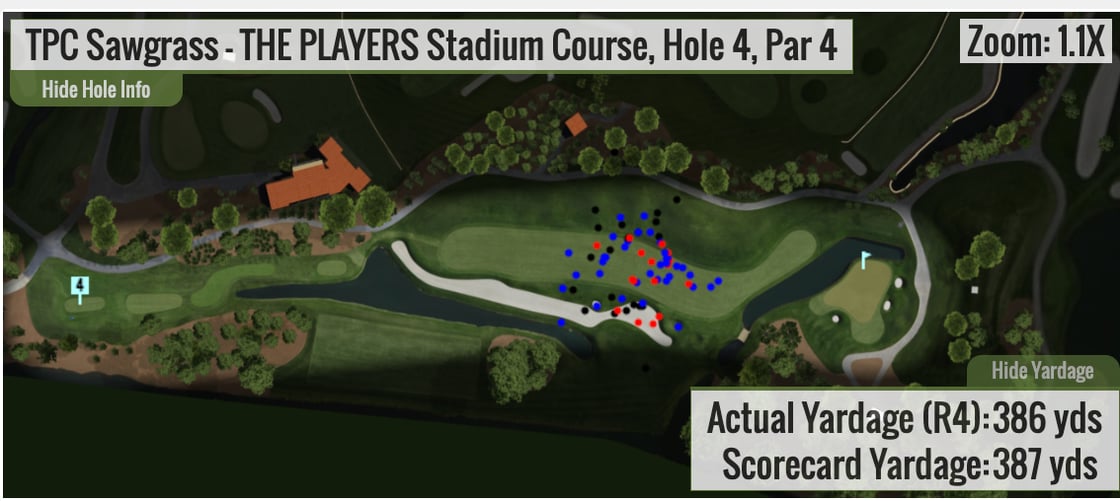

No. 11 at Sawgrass similarly penalized errant tee shots by removing the chance to go for the green in two and forcing a conservative second shot. While hardly spitting images of one another, the par 5 at Sawgrass shares some playing characteristics with the par-5 11th at MVGC.


Thick rough may not be everyone’s cup of tea, and I’d prefer if golf courses could provide a stout test without resorting to six-inch rough, but it was a proper, challenging setup at TPC Sawgrass over the last four days. And the players most equipped to handle the test revealed themselves.